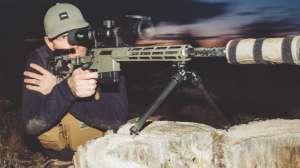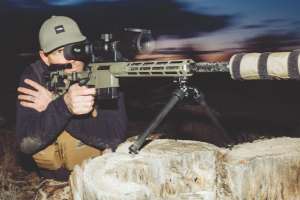

Few hunters today speak in hushed tones of 300-yard shots. Scopes, bipods and faster bullets with high ballistic coefficients sharpen their aim, steady their rifles and permit a dead-on hold to great distances.
The popularity of sub-.27-caliber cartridges for deer hunting has surged with the proliferation of heavier bullets that hit harder and drive deeper than traditional “varmint” bullets. The 2009 debut of the 6.5 Creedmoor, based on the .30 T/C case, made such bullets practical. Since then, a flurry of cartridges for AR-15s and short-action bolt rifles have appeared, factory loaded with weighty Pinocchio-nose bullets that reduce drag and hike velocity and energy retention.
Depression-era aces such as the .220 Swift and the (then-wildcat) .22-250 still kick 50-grain bullets at nearly Mach 4, but their design and established rifling twists are poorly matched to new 80-grain bullets bumping BCs above .480. Shooting far, you want fast-twist .223 barrels for 69- to 75-grain match bullets, or rifles in .22 Nosler, .224 Valkyrie, .22 ARC or .22 Creedmoor. Barrels for these four have spins sharp enough for 70- to 80-grain bullets. And the cases hold enough powder to launch them at 3,000 fps.
New 6mm, .25-caliber and 6.5mm long-range cartridges also beg fast rifling twist for the heaviest bullets. But the range of bullet weights (thus, lengths) isn’t as great as for .22s. Hornady loads the 6mm Creedmoor with match bullets as heavy as 108 grains, game bullets up to 105 grains. Notably longer than the 100-grain bullets standard since the 1950s in 6mms, they’re just a little heavier.
The new .25 Creedmoor arrived with 128-grain bullets; but wildcatters were using 120-grain bullets in the .25-06 Rem. before Sputnik. The 6.5 Cm’s sleek 147-grain match bullets weigh less than Norma’s 156-grain softpoints for the 6.5x55mm. Bullet length matters much more than bullet weight in determining proper rifling twist.
Muscle Bound Minis
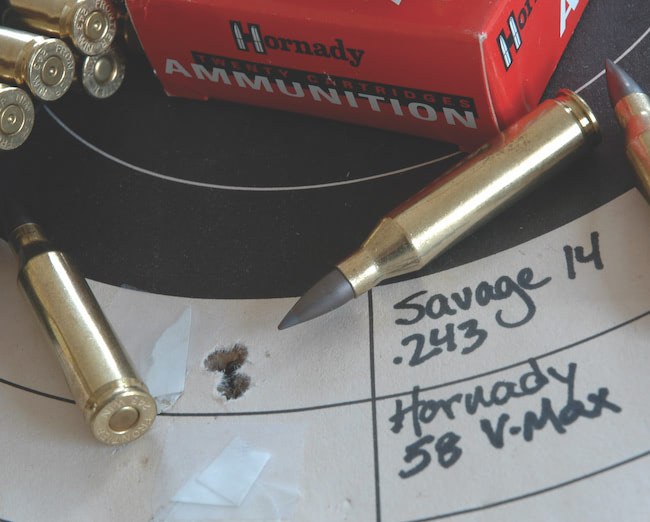
Adding muscle to .22 bores takes them from the varmint-predator box and, with bullets of proper design, punches their “dual-purpose” card. With the .243 Win., .250 Savage, .257 Roberts and efficient 6.5s, they’re bona fide deer cartridges. Intelligently loaded, the .223 Rem., .22-250 Rem. and .220 Swift have proven lethal on 200-pound game. New bullets with the heft of 6mms, clocking nearly Mach 3, should erase any doubt.
But the need for long-range .22s — or, for that matter, 6mms, .25s and 6.5s — in game fields begs a little thought. Most of my kills on predators and big game have come at modest ranges. Of the black bears I’ve shot, only one (raiding a camp kitchen on treeless tundra) at over 180 yards. My first and most recent both fell to rifles with metallic sights at less than 45 steps.
As coyotes on my little orchard sing nicely, I give them some slack. But elsewhere .22 centerfires under big optics have brought me a few pelts. Hunting method affects shot distance, and as I find walking therapeutic, you might expect my pokes to be longer than if animals shuffled up to me. Still, whatever the rifle in hand, 300 yards looks far, and average kill ranges are well shy of 200 yards.
I find that choosing cover intelligently and “hunting it close” brings short shots. This past fall, a hunter with much better eyes than mine joined me on a broken slab of Northern prairie. He spotted several deer to my one. All were far away. But, glassing, he overlooked a buck just 90 yards off. I saw it because I was looking where my .30-30 Win. with metallic sights was effective.
Real-World Comparisons
A 55-grain varmint bullet or a 60-grain Nosler Partition can be driven flat and accurately at 3,600 fps from standard .22-250 rifling. Whether it’s coyotes or venison, the “Varminter” is a lethal club. Can you gain anything by using a .22 Creedmoor? That depends. An 80-grain .22 Creedmoor bullet better fights drag, and within 200 yards catches up with the 55-grain .22-250s. At 400 yards it’s traveling over 300 fps faster.
But bullet drop at 400 with a 200-yard zero is essentially the same! A 15-inch holdover lands your bullet within an inch of center with either load. While the .22 Creedmoor has twice the .22-250’s energy at that range; you may not need 2,270 fps and nearly half a ton of energy to kill. The .22-250 is an appealing option. Its 6 foot-pounds of recoil in an 8-pound rifle hardly bumps the muzzle. The .22 Creedmoor registers 9 foot-pounds. The cost of .22-250 cartridges and components is less, too.
Comparisons pitting traditional 6mm, .25s and 6.5s against the Creedmoors yield similar results in regard to velocity and energy retention at distance, and bullet drop. The .243’s 95-grain SST gives up its initial 135 fps velocity edge in 200 yards. At the 400-yard mark, the 108-grain ELD-X of the 6mm Creedmoor has more than reversed the advantage. But again, bullet drop at that range is within an inch of the same. An 18-inch holdover yields center hits. As the 6mm Creedmoor’s bullet is just 8 grains heavier than the .243’s, the difference in impact energy beyond 200 yards isn’t as great as is the case with the .22-250/.22 Creedmoor comparison. The .243 brings 800 ft./lbs. to 500 yards, enough to dump deer. The 6mm Creedmoor hits more than 25% harder.
Recoil in 8-pound rifles is about 10 ft./lbs. for either load, the .243’s higher exit speed offsetting the 6mm Creedmoor’s bullet weight advantage. The .243’s long popularity gives it the edge in ammo and component cost.
The 128-grain bullet of the new .25 Creedmoor gets off the blocks just 100 fps behind the 117-grain SST from the .257 Roberts +P load. And in just 100 yards it has erased that lead. At 200 yards, it has an 80-fps edge on the Roberts. At 400 yards the gap has widened to 230 fps, on its way to 300 fps at 500 yards. The contribution of a high BC shows clearly in this comparison, which gives the .25 Creedmoor an energy advantage of over 400 ft./lbs. at 500 yards — though on exit its edge is just 50 ft./lbs. Here again, at 400 yards the difference in drop between these two bullets is slight: just 1.5 inches. Aiming 20 inches high ensures a kill with either load. Recoil is nearly the same: 11 ft./lbs. from the Roberts, about 12 for the .25 Creedmoor.
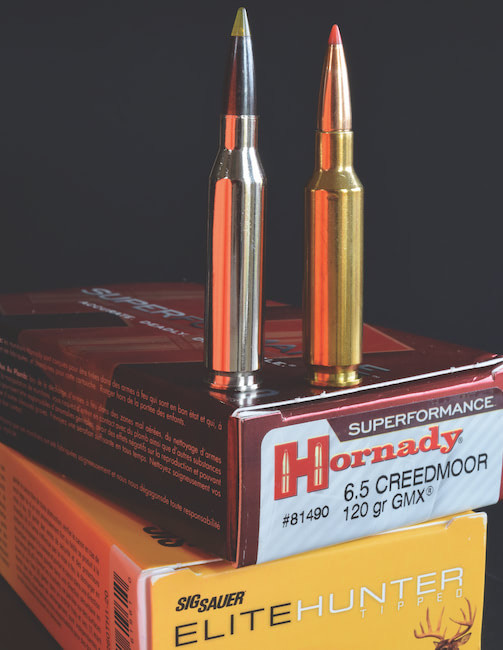
Hornady loads sleek 129-grain SST bullets in the .260 Remington and 6.5 Creedmoor to almost identical speeds. They stay neck-and-neck past 500 yards, where velocities differ by less than 20 fps. The 6.5 Creedmoor shines at long range when loaded with Hornady’s 143-grain ELD-X bullet. Starting with a speed deficit of 230 fps, the 6.5 Creedmoor barely reels that in over 500 yards of flight. It’s a slow gain, courtesy the SST’s high BC. The ELD-X’s 14-grain weight advantage brings its energy up to that of the SST within 200 yards. At 400 yards, the 6.5 Creedmoor bullet has 80 ft./lbs. more punch; that margin crawls to 110 ft./lbs. over the next 100 yards. Both bullets land killing blows on deer-size animals as far as accurate shooting is possible afield. Bullet drop at 400 yards differs by 2.5 inches. Holding 21 inches high brings bullets from either load within 1.5 inches of center. There’s negligible difference in recoil: about 13 ft./lbs. from 8-pound rifles.
To sum, the Creedmoors — .22, 6mm, .25 and 6.5mm — excel at distance with bullets designed for shooting far and given sharp spin. To 400 yards, sleek but not overly long bullets from peppy traditional cartridges fly as flat as Pinocchio-nose missiles from Creedmoors. So at any distance to 400 yards, you can hold the same with the load pairings illustrated here. The ballistic advantage of the Creedmoors increases with range — though hitting deer or coyote vitals beyond 400 steps begs more than good numbers on charts.