Selling Shotguns is easy, but doing so requires an understanding of chokes and how they work. It also helps to qualify which type of customer you’re dealing with.
When most people discuss shotguns, they talk about whether to choose a pump or semi-auto, or what gauge or brand will best suit their purposes. If, however, you talk to a seasoned hunter, the discussion will likely center around distances, chokes and shot patterns. Successful hunting requires shots on target, or in this case the amount of shot on target.
Early Development
Shotguns have been around for centuries and have been the choice of those who could only afford one gun. Their advantage was the ability to send multiple projectiles downrange with each pull of the trigger. The traditional projectiles were small lead balls (shot) that were packed into the chamber and all fired at the same time. These projectiles traveled through the barrel together and immediately began to disperse after leaving the muzzle. Rather than a single bullet, they produced a spray pattern that grew wider as it traveled away from the gun. This was both the shotgun’s biggest advantage and its biggest disadvantage. They were deadly to small game and birds at close range but lacked the precision for longer shots.
By the mid 19th Century, gunmakers discovered that they could improve the shot patterns by slightly reducing the shotgun’s bore diameter in the last few inches near the muzzle. The effect was to force the shot more closely together as it left the barrel, which increased the distance before the shot began spreading into a pattern. These “choked” barrels increased in popularity and were prized for their improved range.
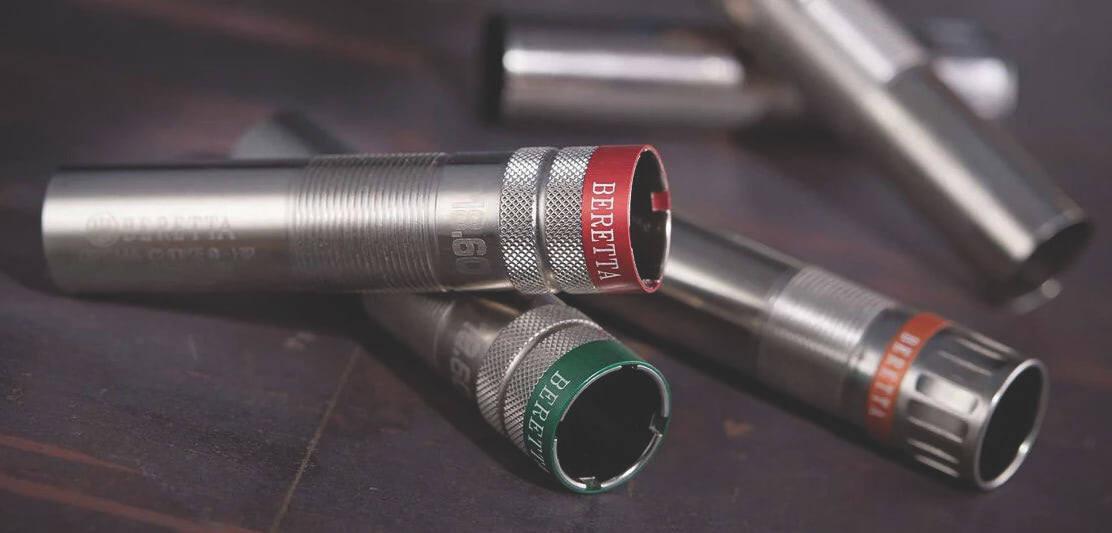
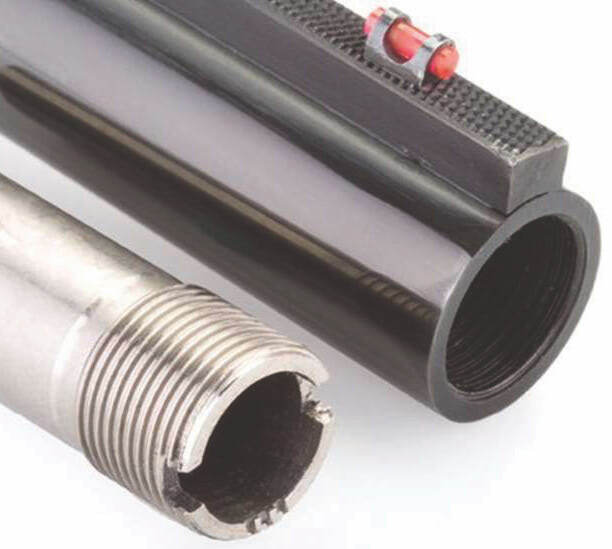
About a hundred years later, gun manufacturers began threading the last few inches of shotgun barrels so that screw-in chokes of varying diameters could be used. Rather than having a fixed choke pattern, shotguns could be rapidly changed from one profile to another based on the expected shooting conditions and the game being hunted. These screw-in parts became known as chokes.
Standard Options
Over time, chokes became standardized based on the amount of constriction they imparted on the shot. The standard, unmodified shotgun bore became known as a “Cylinder” bore. The next in line had a .010-inch constriction to match the originally modified barrels. These were called “Improved Cylinder” bores. Each new constriction was given a name, and these conventions are still in use today.
The four most common chokes are Cylinder (no constriction), Improved Cylinder (.010-inch constriction), Modified (.020-constriction), and Full (.040-constriction). Each constriction increases the percentage of pellets remaining on target at longer ranges. The Cylinder Choke kept 80% of the pellet on target at 20 yards. The full choke nearly doubled that effectiveness by retaining 70% of the pellets on target at 40 yards.
Getting a Pattern
Beretta’s choke identification chart provides approximations to illustrate the effects of different chokes. The actual percentages will vary based on the brand of shotgun and ammunition, the shot size, and even the material the shot is made of. The only way to know how a shotgun will pattern is to actually pattern it with the specific shotshells and choke combinations.
To pattern a shotgun, fire it at a paper or wooden target that is 40 inches across and 40 inches tall then count the percentage of pellets on target. This can be recorded and compared to other chokes with the same shotshell or different shells with the same choke. Only then will the results be clear. This is something that everyone should do but most never will. It’s one factor that sets a true competitor or hunter from a casual one.
Traditional or Alternative
The material used for shot has traditionally been lead. Lead balls were made in gradually increasing diameters from the smallest (12), measuring .050 inches up to 000, which measures .36 per pellet.
Since lead is now considered harmful, manufacturers have sought to use different materials such as steel, bismuth, or tungsten that are considered non-toxic. This must be considered when patterning a gun. Each of these materials has different characteristics than lead and will be affected differently using the same chokes. A No. 6 lead ball will not pattern the same as No. 6 bismuth. Likewise for the other choices. If you want to know what it’ll do, it’ll have to be patterned.
Good Guidance
Different materials, powders, and brands have their own characteristics affecting shot patterns, but the most dramatic effect is still based on choke selection. So how do you help your customers choose the right one? That requires knowing the game they’re after and the typical range associated with it.
Quail and Pheasant are typically smaller, fast-moving and are flushed at relatively close distances like 30 yards. The fast action and short range make an open choke the best. This provides a wide pattern with the best chance of a clean kill without damaging the birds.
Hunting ducks and geese requires longer, slower shots. Larger shot will be used with a more constrictive choke, such as a Modified or Improved Modified. This combination will give improved range and shot density for these larger birds.
Turkey hunting is entirely different. Rather than creating a shot spread, targeting a turkey’s head calls for a tight shot pattern and a carefully aimed shot. Typical choices are Full or XX Full chokes.
Sporting clays and skeet shooters, where distances can vary widely among targets, often use a Cylinder choke in one barrel and an Improved Cylinder in the second barrel. Trap shooters may also vary their chokes between the first and second shots since the second shots are much farther than the first. Many use Full chokes to overcome the difference.
Self-Defense Considerations
When using shotguns for home defense, the best choice is Cylinder or Improved Cylinder. More restrictive chokes can deform the larger shot sizes that are typically used, drastically decreasing accuracy. If slugs are used, the choke will depend on the type of slug. Rifled slugs are designed for use in smooth barrels and work best with a cylinder choke. Standard slugs are designed for use in a rifled barrel. If used in a smooth bore, there are specialty chokes that provide rifling over the last few inches of the barrel. These can help improve their stability by imparting a stabilizing spin during flight.
Regardless of the objective, there’s a choke and load combo perfectly suited to the task at hand. Help your customers understand how to make those decisions and they’ll have a better experience behind the trigger and in your store.