
Mention the term “smart guns” among people working in the shooting sports industry and you can expect some very negative reactions.
“Anti-2A groups want it, so I know it’s a bad thing!”
“They don’t work and never will!”
“They are embedded with tracking devices. No, thanks!”
Understandable reactions given the history here.
That history started in 2002 when New Jersey politicians passed a law mandating that, within three years of a smart gun actually coming to market, all guns in New Jersey must be smart guns. This law was repealed and replaced in 2019 with a new law that now mandates that each New Jersey FFL has to offer a smart gun for sale once such guns are available to consumers and are approved by the state.
The first New Jersey law ran into a basic problem: The technology simply did not exist to make such a gun. Second Amendment advocates opposed the mandating focus of the law. They worried that if such a smart gun even came to market, people would be forced to buy and use what was at the time only an unproven idea.
Basically, a “smart gun” is a firearm that only authorized users can access. One way to accomplish this is by incorporating a biometric system within the gun itself to recognize these users. Biometric refers to the ability to measure and analyze certain human characteristics and use that data for security purposes.
Other identification systems were tried, too. Yet, whatever the system, these smart guns didn’t work as advertised.
Improving Technology
Past failures notwithstanding, today a pair of companies produce working user-only authorized pistols. My review of the LNK9 made by Lodestar Technology appears elsewhere in this issue. In my time with it, the 9mm LNK9 functioned as a pistol should and only allowed me, the single authorized user, to use the firearm.
No doubt, other user-authorized firearms will appear in the years to come as the technology continues to improve. Which begs up all sorts of questions:
– Is there actual demand for such firearms?
– Could these smart guns open up whole new markets?
– Should FFLs consider offering such firearms?

Lodestar
The semi-automatic LNK9 is manufactured by Lodestar Technology, Inc. of Chattanooga, Tennessee.
The LNK9 uses a fingerprint recognition pad embedded in the grip to verify authorized users. There is also a secondary authentication method through a secure PIN code entry, also accessed on the pistol’s grip. The Lodestar Technology mobile application allows the owner to add or remove authorized users and adjust settings, and the app is compatible with iOS and Android.
Once I received my T&E LNK9, I followed the instructions to set up the fingerprint recognition and the PIN code. Then, I took it to the range and not only used it but had a half-dozen other people try to use it. The pistol stayed locked and inoperable with these non-authorized users.
Chambered in 9mm, my test LNK9 featured a striker-fired trigger and semi-automatic action. Mine came with two 17-round magazines. At my shooting range, the pistol soon proved itself a capable home defense and concealed carry option.
Lodestar designed the LNK9 very much with past “smart gun” criticisms and fears in mind, including the concerns that third parties could access smart gun information and track users.
To that end, LNK9 does not have GPS tracking capabilities, and functions as a fully self-contained system with no connection to government, law enforcement, or third-party networks. No outside party has access to the LNK9 or its settings.
Biofire
“Always Locked. Instantly Accessible.”
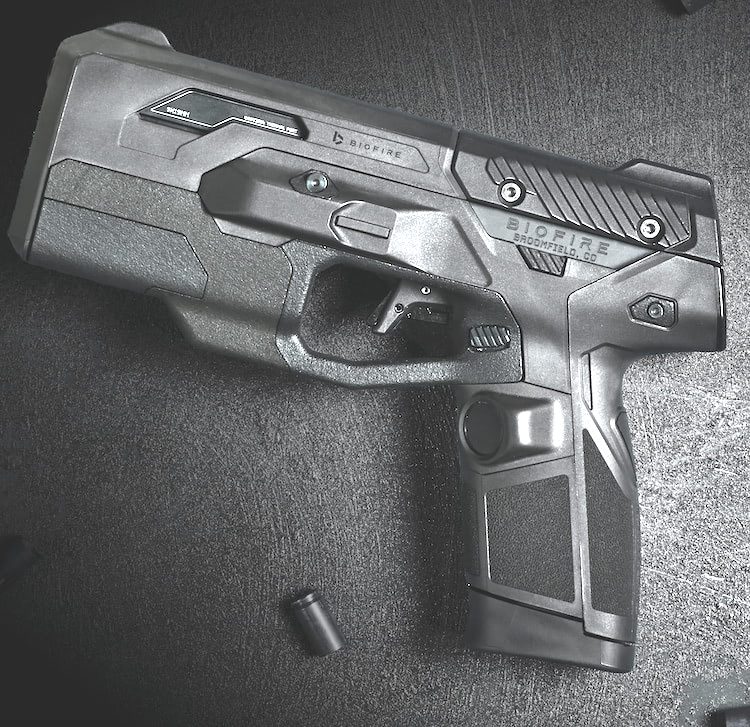
That’s the promise of the Biofire Smart Gun, which has and continues to ship to customers.
The pistol uses fingerprint identification and a 3D facial recognition system to independently verify user identity. The latter is accomplished with a tiny camera at the very rear of the slide. According to Biofire, the pistol locks up as soon as it leaves the hand of an authorized user.
The company’s website notes that, “Biofire’s secure fire-by-wire technology with encrypted fire control is a new paradigm in handgun technology. Solid state electronics ensure no one can mechanically modify your Smart Gun to circumvent its biometrics. Even if your firearm is stolen, it can never be used.”
The Biofire Smart Gun has no wireless connectivity of any kind, so user biometrics never leave the pistol. As the company website adds, “No one can access your biometric data, ever — not even Biofire.”
Semi-automatic and striker fired, the 9mm Biofire Smart Gun sells with 10- or 15-round magazines. Customers can also order their Smart Gun with custom color combinations and a full lineup of accessories.
Nonstarter
Past versions of similar guns include the Armatix iP1. This .22LR caliber semiauto pistol incorporated a Radio-Frequency Identification (RFID)-connected authentication link between a watch and this pistol. You had to wear the watch for the pistol to fire.
Introduced to the U.S. in late 2013, early 2014, the Armatix iP1 looked like it might actually launch the 2002 New Jersey law into effect. But New Jersey tried out the pistol and determined it didn’t meet the law’s requirements.
In 2017, the iGUN appeared. Here, the user-authorization system is known as the Magnetic Tag Firearm System. It is similar in some ways to the RFID approach, with the user wearing a ring that allows him or her to fire the gun once they pick it up. Otherwise, the gun remained locked and unable to fire.
The iGUN Technology Corp. built and tested a number of iGUN models and generated some media coverage. But the brand never took off.
As the iGUN Website notes, “Unfortunately, there has not been enough demand for them to be brought to large scale production. Once enough demand exists, and if certain other conditions are met, they will be introduced. We are working on plans to introduce this product to select markets but will do so only in a free-market environment. NO MANDATES.”
The Resistance
The National Shooting Sports Foundation led the smart gun “resistance” when New Jersey politicians created their smart gun mandate plan over 20 years ago. NSSF issued press releases and fact sheets about the failings of guns and pushed back in the media on the idea of mandating what is a Constitutional right to own and bear firearms.
A 2022 press release posted to the NSSF website and shared on firearm media outlets entitled, “Don’t Believe the Hype. Smart Gun Tech Still Not Ready for Primetime,” noted that authorized-user pistols invariably employ built-in electronics.
As author Larry Keane wrote, “Firearm owners know that guns must work as designed each and every time. There’s no room for failure. Adding in electronics to guns adds points of failure and could have horrific consequences for those who rely on them for self-defense.”
Keane, of course, is senior vice president for government & public affairs and general counsel for the NSSF.
His post also noted the firearm industry’s opposition to “smart gun mandates” of the kind that surfaced in New Jersey. Among Keane’s concerns were the legal liabilities to industry retailers if the smart guns failed to work.
Yet, as Keane also added, “To be crystal clear, the firearm industry doesn’t now, and has never, opposed the research and development of ‘smart’ gun technology. What we believe is that the marketplace should decide if this technology is truly ready for market.”
No Mandates
In testimony presented to the Massachusetts Special Legislative Commission on Emerging Firearm Technology in April 2025, Kai Kloepfer, founder and CEO of Biofire, very clearly stated his opposition to any form of legal mandates for smart guns.
As Kloepfer said, “Let me state Biofire’s core policy position clearly: We oppose any law that would mandate, whether de jure or de facto, the use or sale of personalized firearm technology. We aim to develop technology that delivers choices, not restricts them.”
Likewise, Ginger Chandler, firearms industry veteran and co-founder of Lodestar Technology, said her company takes a similar position.
"We believe safety innovation should come from people who understand firearms,” Chandler told SSR. “We respect choice, tradition, and safety. As firearm industry veterans, we're taking this responsibility seriously.”
Of course, Biofire and Lodestar opposing mandates will not stop mandates from occurring. After all, we live in a time where one state’s politicians, California, recently passed a law that effectively prohibited the sale of most Glock pistol models.
Given New Jersey’s previously mentioned 2019 law, will FFLs there have to offer a smart gun option? Not for now, it appears.
“New Jersey's Personalized Handgun Authorization Commission must first accept a ‘smart’ gun for their roster of approved handguns,” Mark Oliva, NSSF’s managing director public affairs, explained. “Once the commission accepts a handgun that it approves, then the requirement for FFLs to offer at least one to customers will begin.
“FFLs will be required to offer that one ‘smart’ gun option within 60 days of it being accepted by the commission,” he continued. “The original 2002 law that would have required all New Jersey guns to be ‘smart guns’ was within 30 months.”
To date, no firearm has been submitted for consideration, and it is the gun maker that has to submit a firearm to the Commission.
Smart Appeal
Of note, the LNK9 sells via the Lodestar website, and then ships to an FFL for the required background check and transfer. But that’s just the start. Lodestar Technology is hard at work creating in-store marketing materials and other dealer initiatives and incentives and is actively recruiting dealers.
Lodestar co-founder Ginger Chandler noted that the LNK9 can appeal to many different customer segments within our industry. This can include people who’d like a firearm in the house for protection but are worried about the gun being stolen or misused, as well as those who hesitated to purchase a firearm because traditional storage and access methods did not fully meet their needs.
“And households looking to replace their bedside-table firearm with one that cannot be accessed by children or intruders are a real possibility for the LNK9,” Chandler noted.
Which is exactly the Biofire Smart Gun’s market, said Bryan Rogers, Biofire co-founder and chief designer.
"This is your nightstand gun,” Rogers said. “One that gives you peace of mind that no one else can use it.”
The Biofire Smart Gun is only sold via the Biofire website, though the long-term plan will likely include FFL retailers, Rogers noted.
This technology is not going away, and one can only guess at what high-tech features will make their way into firearms in the future. At some point, FFLs will have to decide whether or not they want to be a part of this brave new world of firearms.