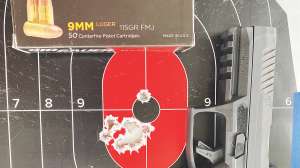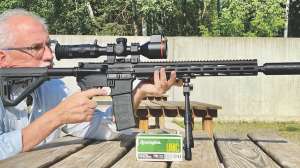
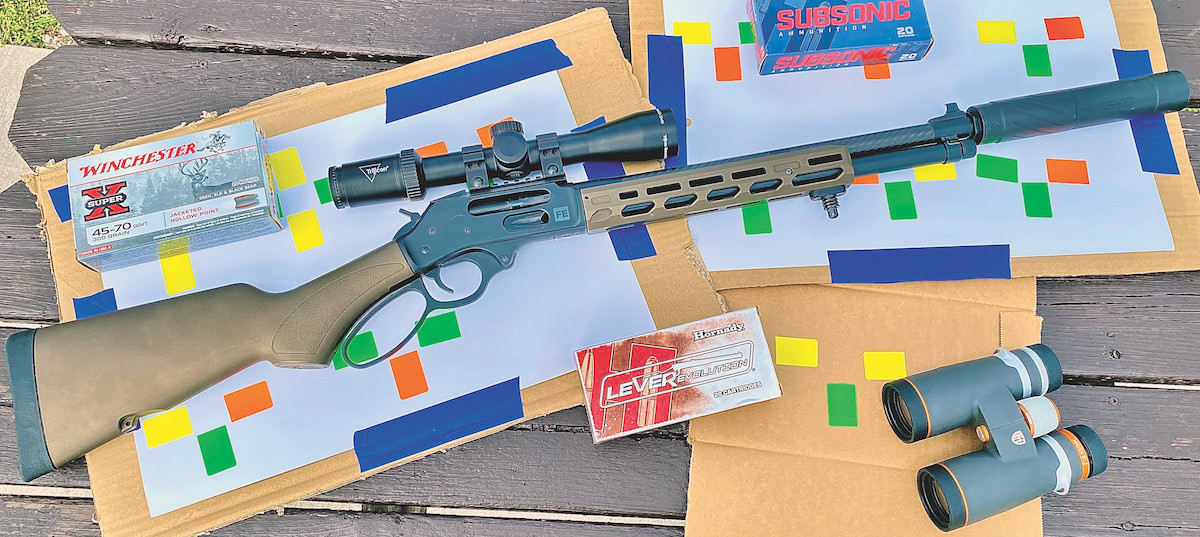
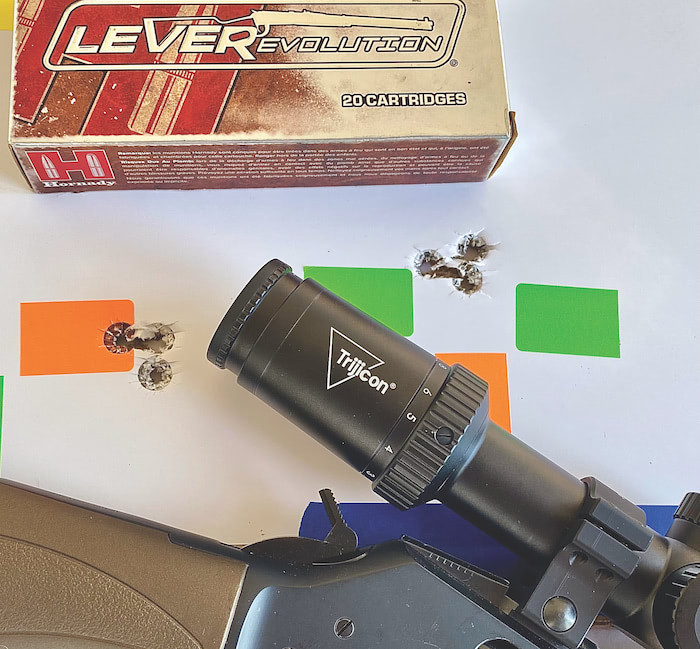
From my shooting table 100 yards away, my first three-shot group with the Henry Repeating Arms SPD CRUSR lever action definitely looked tight. But it also hit right about 1.5 inches from my center aim point. I gave the windage knob on my Trijicon Huron 2-10x40 six clicks left, reloaded and fired another triple.
Once again, the CRUSR and the Hornady .45-70 Gov’t. LEVERevolution clustered tight.
I had more shooting to do, but between this initial accuracy, the crisp trigger, and the smoothness of the lever’s action, I was already impressed with the Henry SPD CRUSR. And I stayed just as impressed through the rest of my time with the rifle.
Guide Gun
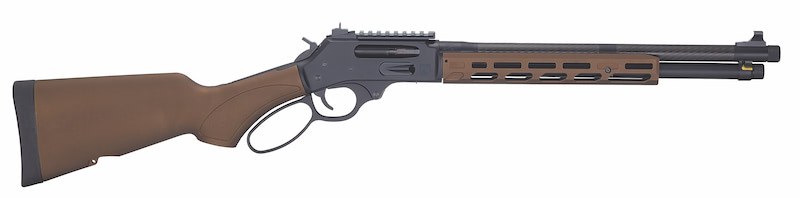
“The SPD CRUSR is intended to be the ultimate ‘guide's gun,” according to George Thompson, Henry’s director of product. “What we mean by that is that it is reliable, durable, accurate, adaptable, lightweight and has enough power to stop anything in its tracks.
“The reliability comes from Henry's proven lever-action system, it's both robust and smooth cycling to handle decades of use. The durability comes from metal finishing with cerakote externally, and DLC internally. Accuracy is improved by the match-grade carbon sleeved and tensioned barrel.”
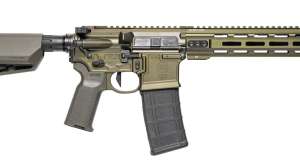
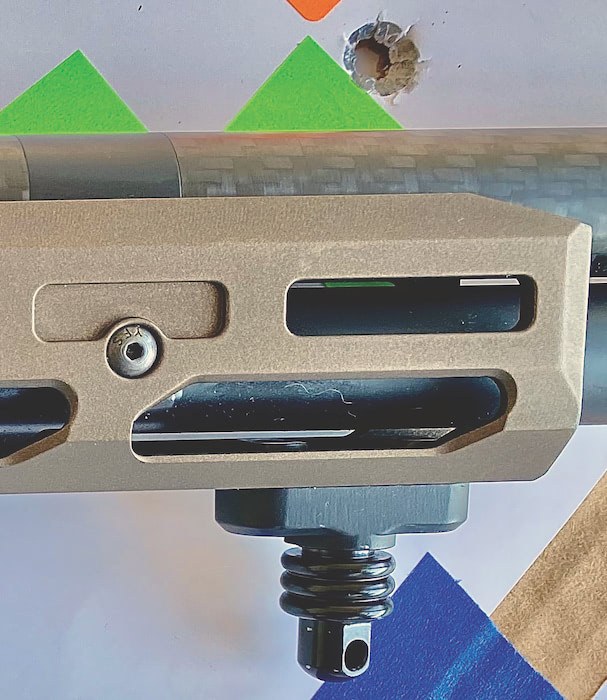
Adaptability comes courtesy of the aluminum handguard and its many M-LOK attachment points for adding a sling, bipod, a light and even a tactical foregrip.
With its carbon-fiber barrel, skeletonized forend and synthetic stock, the CRUSR weighs in at just 6.7 pounds unloaded. Stopping power? The rifle is chambered exclusively in .45-70 Gov’t. With the right ammunition, there’s really nothing in North America the rifle/round can’t bring down, and it will more than hold its own on the other continents, too.
Hence the rifle’s very name, CRUSR, which I pronounce as crusher.
Advanced R&D
Henry’s Special Products Division is the company’s advanced research and development group within the larger organization. In 2025, SPD introduced its first creations, the SPD HUSH rifles in .30-30 Win, .357 Magnum/.38 Spl, .45 Colt, .44 Magnum/.44 Spl, .30-30 Win, and .45-70 Gov’t.
They followed up with the magazine-fed SPD Predator Rifle in .223 Rem./5.56 NATO, and most recently the CRUSR Rifle. Given both the quality of the SPD rifles and the interest they have garnered, I expect to see more SPDs in the near future.
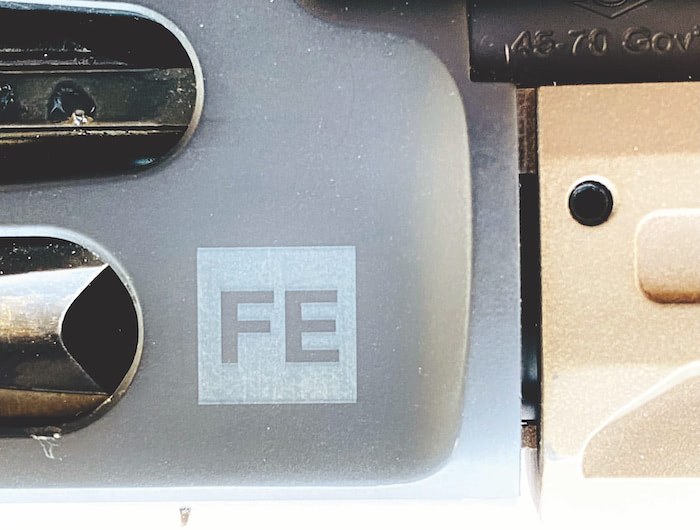
SPD collaborated with the gear development team at Field Ethos to create the CRUSR, attested to by the ghosted "FE" logo on the right side of the receiver.
Built Tough
With its 16.5-inch barrel, the CRUSR measures out at a nifty 35.325 inches overall. As Thompson noted, the barrel is carbon-fiber tensioned over a 416R stainless steel insert with a 1:22 twist rate. The end of the barrel is threaded at 5/8x24.
The rifle sports 4+1 ammunition capacity, with ammo added through the loading gate on the ride side of the receiver or via the magazine tube. A suppressor on the end of the barrel, though, blocks the end of the mag tube.
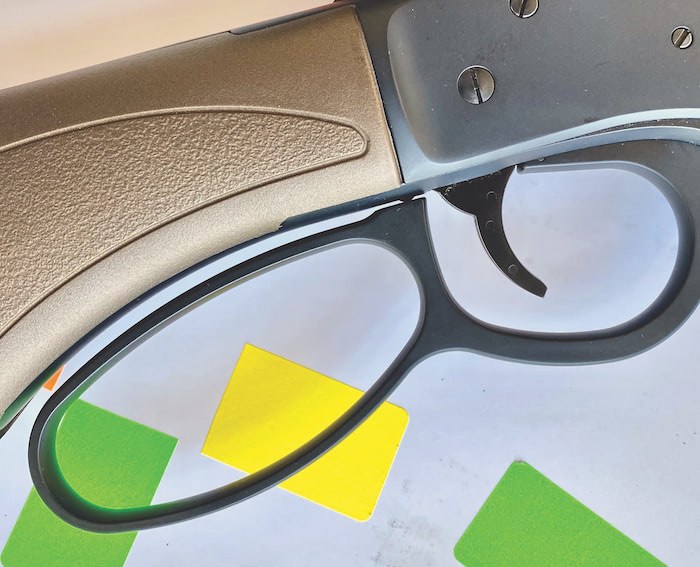
The trigger on my test model CRUSR broke at a crisp 2 pounds, 4 ounces on average with just the very slightest bit of take up.
The rear sight is an adjustable ghost ring, the front a shiny brass bead. A Picatinny rail is factory-mounted onto the Midnight Blue Cerakoted receiver.
No manual safety but the rifle has a transfer-bar safety that stops the hammer from striking the firing pin unless the trigger is pulled. This ensures that the rifle won’t fire if the hammer is accidently banged or the rifle itself is dropped or both.
The synthetic stock features a textured pistol grip, a solid rubber recoil pad and a sling attachment point near the bottom end of the stock.
Henry/SPD DLC-coated the CRUSR’s high-wear parts, and Midnight Blue Cerakoted all other exposed exterior parts. SPD also applied Midnight Bronze Cerakote on the M-LOK aluminum forearm and buttstock.
Making the CRUSR able to withstand the toughest elements a hunter or guide might encounter.
Lever Suppression
Yes, the CRUSR is one lightweight .45-70 and I initially shot it without a suppressor; it was a shoulder full of thump. No knock against the rifle. The recoil was simply the reality of a heavy .45-70 Gov’t. bullet rocketing out of a less-than-heavy platform.
Yes, I prefer the rifle with a suppressor, and most of my shooting was with a Banish 46-V2 Suppressor direct threaded onto the end of the barrel.
The BANISH 46-V2 suppressor handles big-bore rounds including .338 Lapua, .45-70 Gov’t, and .450 Bushmaster, plus handgun calibers like .357 Mag, 10mm Auto, and .45 ACP.
Made of titanium, the Banish 46-V2 weighed in at just 15.3 ounces and was only 8 inches long. The suppressor definitely cut muzzle blast and shaved off recoil.
To truly judge a rifle’s accuracy at any decent distance, I need a scope. In this case, I went to the Trijicon Huron 2.5-10x40 scope.
Made specifically for the North American whitetail deer hunter, the second-focal plane Huron featured a Bullet Drop Compensating reticle, a tough aircraft-grade aluminum 30mm main tube, and .25 MOA elevation and windage adjustments.
Weighing 18.2 ounces, this Huron measured out at only 12.55 inches and sported capped adjusters. To mount the scope, I relied on Trijicon’s rugged 30mm low scope rings.
Real Accuracy
My accuracy testing of the CRUSR began at my outdoor range with an initial 50-yard zeroing of the Huron. This took five shots.
At my 100-yard lane, I fired off those afore-mentioned three rounds of Hornady LEVERevolution .45-70, adjusted the Huron and fired three more times. Both groups measured .75 inches. I fired three more rounds, and this group came out to 1.1 inches. Hornady loaded these LEVERevolution rounds with the company’s 325-grain FTX bullets.
I switched over the Winchester SuperX rounds and their 300-grain jacketed hollow points. I fired a couple groups to get my bearings with the new round, let the rifle cool down and then shot three, three round groups. They measured out at .90, 1.o and 1.35 inches.
Last, I took on something new: Hornady’s Subsonic .45-70 loaded with 400-grain SUB-X bullets, my very first time running any subsonics in this big-bore round.
At 100 yards my first trio of shots grouped well, but, and as I expected, very low given their subsonic velocity. Ten inches low, and 3 inches to the right. I made the necessary adjustments to the Huron and fired three groups of three for accuracy.
Groups measured o.90, 1.0 and 1.15 inches.
Hornady rates the Subsonic round at 1,000 feet per second at the muzzle or half the velocity of the LEVERevolutions, though no doubt those numbers are based on a 24-inch barrel. For hunting, I’d need to chronograph this ammunition in the CRUSR to determine actual fps and energy.
But the rounds and the Banish V2-46 definitely created a much softer-shooting .45-70, and accuracy was amazing.
Fully Optimized
There’s been an assumption across the firearms industry that newer lever actions built with more modern, high-tech features don’t appeal to lever-action “traditionalists.” I asked Thompson if he thought the assumption was correct.
“Not really,” he said. “The traditional lever-action folks tend to be very accepting of the modern looking products, and I think it's because at the heart of these modern guns are the same classic lever guns — in the same calibers. The new levers are just being optimized in ways that weren't available 40 years ago.”
One huge optimization built into levers like the CRUSR and HUSH models is the use of suppressors. But it goes beyond that. Once you can suppress a lever action (which was not common even a decade ago), and your lever action sports a rail on the receiver, now you’ve made optics that much easier to mount onto the rifles.
Different types of optics are now possible, too. For example, I successfully hunted hogs at night with a HUSH lever chambered in .357 Mag., suppressed and complete with a thermal scope atop the receiver. Making a lever capable of doing such a hunt would’ve been very difficult years ago.
With its M-LOK-ready forend, a hunter can easily add various slings, bipods and even lights to the CRUSR. One CRUSR sales technique: trick it out so customers understand just how the rifle can be customized for their specific uses (which can also drive some additional accessory sales).
Sales Training
Becoming a Henry Repeating Arms dealer is as easy as ordering Henry products through an industry distributor, as Henry does not sell direct to dealers.
Henry sells to all the major distributors, including Amchar, Bill Hicks, Camfour, Chattanooga Shooting Supplies, Crow Shooting Supplies, Davidson’s, Iron Valley, Lipsey's, MGE, Ron Shirk, RSR, and Sports South.
For its dealers, Henry offers sales staff training on a case-by-case basis.
“If there are any dealers out there that would like some product training, we'd be happy to accommodate,” Thompson said. “Reach out to us, and we'll set it up.”
Likewise, he added, if any current Henry dealers do not have Henry signage, “I'd encourage them to reach out to us, and we'll get them squared away.”
Henry Guarantee
Last, Thompson encouraged Henry dealers to stress the Henry durability and reliability to their customers. Both are reflected in the Henry Guarantee which includes a lifetime warranty for the life of the product.
As they know all too well, FFLs operate on thin margins for firearms. If a customer returns to the store with a problem, the dealer is losing that margin simply by staff taking time to resolve the issue.
“With Henry, that's not the dealer's problem; it's ours,” Thompson noted. “All they have to do is give the customer our number and I guarantee we will make it right. It's our product that is the issue and we don't shift that burden to dealers. In the long run, this adds real dollars to their bottom line.
“Even with this and the Henry Guarantee, our warranty rates are among the lowest in the industry. Bottom line is we make a damn fine product, so it's easy to stand behind it, and that adds a good deal of value to the customer and the dealer.”