
Few firearm designs have stood the test of time quite like the lever action.
Despite the earliest attempts at this design dating back to the early 1800s, the platform didn't truly gain traction until Benjamin Tyler Henry unveiled his now-famous rifle in 1860. It was this very rifle that ultimately helped lay the foundation for the lever-action rifles that would follow.
More than a century and a half later, the platform continues to evolve. Manufacturers continue to incorporate new materials, optics-ready receivers, a wider range of chamberings, suppressor-ready threaded barrels and more into their designs, confirming that lever guns are as relevant today as ever. Their mix of tradition and innovation continues to attract hunters, recreational shooters, collectors, and first-time buyers alike.
To get a better sense of where the lever-action category stands today, I recently spent time with four distinctly different rifles that highlight the breadth of the current market. From a lightweight rimfire to modernized centerfire options, each takes its own approach to blending traditional lever-gun appeal with contemporary features.
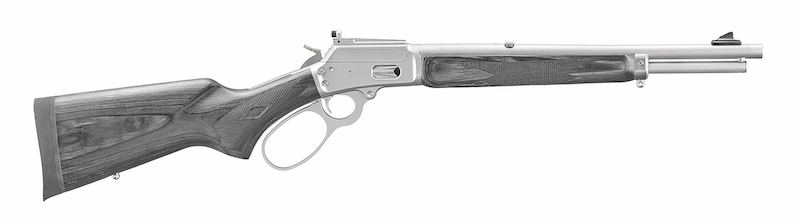
Marlin Trapper Series Model 1894 (10mm)
Marlin's Trapper Series Model 1894 is one of the more interesting additions to the lever-action category, pairing the classic Model 1894 with the increasingly popular 10mm Auto cartridge. It's a combination that's likely to catch the attention of customers who already shoot 10mm handguns and like the idea of keeping ammunition on hand for both platforms. This rifle is compact and well-balanced, measuring 33.25 inches in length with a capacity of 10 rounds. Skinner Sights come preinstalled and consist of a fixed front blade and adjustable rear aperture. Its 16.1-inch barrel is threaded for those who plan to run a suppressor or other muzzle device. Lastly, this lever gun is outfitted with a black laminate stock, checkered along the grip and forend for optimal control during use.
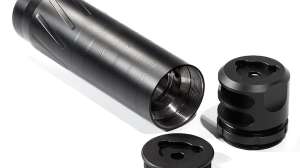
Before hitting the range, I took advantage of the threaded barrel and mounted a Dead Air RXD 910Ti suppressor. Although the RXD 910Ti was developed around the 9mm cartridge, it's also rated for 10mm, and noticeably dropped the report produced by the Hornady 150-grain FTX LeverEvolution load used during testing.
Shooting from a supported bench-rest position 50 yards away from the target, five-shot groups averaged roughly 3 inches, well within the acceptable range of an iron-sighted lever gun chambered in a handgun cartridge. The action smoothed out as the round count climbed, feeding and ejecting reliably throughout the session.
For retailers, it's another example of how manufacturers are broadening the appeal of the lever-action market without losing sight of what made these rifles popular in the first place. The Model 1894 Trapper has an MSRP of $1,599.00. For more information, visit marlinfirearms.com.
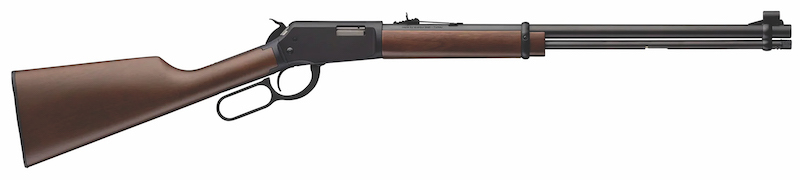
Heritage 92 Black (.44 MAG)
Heritage's 92 Black pays homage to the classic lever-action design that helped define the American frontier, with its wood stock standing in stark contrast to options with a more modernized feel. Chambered in .44 Magnum, this rifle has a 12-round capacity and an overall length of 42.8 inches. Sights are kept simple on the 92 Black, consisting of a drift-adjustable front sight paired with an adjustable buckhorn rear sight. Aside from .44 Magnum, Heritage also offers the 92 Black chambered in three additional pistol calibers, including .357 Magnum, .454 Casull, and .45 Colt.
For ammunition, I chose Black Hills 300-grain JHP .44 Magnum. Firing five-shot groups from the bench at 50 yards, the rifle produced average groups measuring approximately 3.5 inches. The buckhorn sights were quick to pick up on target, though they naturally favored speed over the kind of precision achievable with magnified optics. Throughout testing, the rifle cycled smoothly and was enjoyable to shoot, proving equally at home on the range or afield. The Heritage 92 Black has an MSRP of $1,555.00, with additional information available at heritagemfg.com.
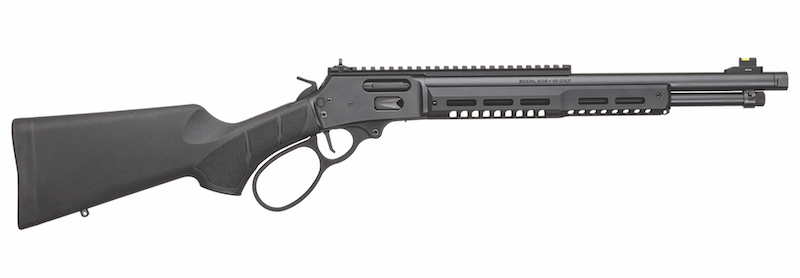
Smith & Wesson Model 1854 Stealth Hunter (.45 Colt)
Smith & Wesson's Model 1854 Stealth Hunter takes a more modern approach to the lever-action platform. The particular model I tested was chambered in .45 Colt, though it is also available in four additional calibers, including .357 Magnum, .45-10 Government, .30-30 Winchester, and .44 Magnum. With an overall length of 33.4 inches, the gun is kept compact even if you opt to add a suppressor to its 16.3-inch threaded barrel. The Stealth Hunter is topped with a HIVIZ H3 front sight and an adjustable XS Sights ghost ring rear sight, which proved to be very quick to pick up on, with an extended Picatinny rail also available for optics mounting. An M-LOK handguard further expands customization possibilities for those looking to outfit the gun with a variety of accessories. Lastly, its synthetic stock has textured grip panels that keep it secure in your hands, with a large-loop lever and flat trigger further adding to the rifle’s modernized feel.
Black Hills' 250-grain RNFP .45 Colt rounds were selected for testing. Shooting from the bench at 50 yards, the Stealth Hunter consistently produced average five-shot groups of approximately 2.75 inches. Cycling the gun took no effort at all, thanks in part to the oversized-loop lever, while its overall size allowed for smooth and quick transitions between targets. The Model 1854 Stealth Hunter has an MSRP of $1,399.00. For more information, visit smith-wesson.com.
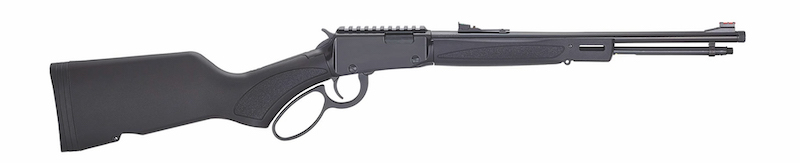
Henry H1 X Model (.22 S/L/LR, .22 Magnum)
Henry's H1 X brings many of the features found on the company's centerfire X Model rifles to a rimfire platform. Two different options are available: The first is chambered in .22 Magnum, a round often selected for use in small-game and varmint hunting, as well as recreational target shooting. The second option, and also the one I was soon to test, is chambered in .22 Short/Long/Long Rifle (.22 S/L/LR). While this trio isn’t offered as often as it was in years past, it allows the H1 X to stand out among others in the rimfire category, especially considering the rimfire market tends to focus heavily on just .22 Long Rifle. The S/L/LR combo provides shooters with the opportunity to use three different calibers interchangeably, while also expanding the various ways you can ultimately use the firearm.
The H1 X has a 16.5-inch threaded barrel and a canted magazine tube that provides enough clearance to reload the rifle without removing a suppressor, should you have one installed. Suppressor-height fiber optic sights come standard from the factory, as well as an integrated Picatinny rail for mounting your preferred optic. Taking advantage of the gun's threaded barrel & Picatinny rail, I installed a Skinner 1-4x20 optic and a Rugged Mustang .22-caliber suppressor before sending rounds downrange.
Two different loads were selected for testing: Federal's 40-grain HammerDown .22 LR and Winchester's 42-grain Subsonic. From the same 50-yard supported bench position the previous lever-guns were evaluated, the subsonic Winchester rounds averaged a 5-round group size of approximately 1 inch. In contrast, the Federal HammerDown grouped slightly tighter at around 0.60 inches. Accuracy was more than adequate for small-game hunting or a casual plinking session, and the fact that it only weighs 5 pounds means it would be easy to carry through the woods. The rifle has an MSRP of $590.00, with additional information available at henryusa.com.
Final Thoughts
For retailers, the biggest takeaway from today's lever-action market is the amount of variety now available. Not every customer walking through the door is looking for the same thing. Some people will be more drawn to the traditional appearance and classic chamberings that more closely reflect lever guns we liken to the Wild West. In contrast, others may be more interested in threaded barrels, optic compatibility, or the ability to customize with aftermarket accessories.
Lastly, one cannot overlook the benefit of being able to pair their new lever gun with a handgun cartridge they already own. Knowing what options are available, what sets them apart from one another, and being able to explain everything effectively goes a long way in helping customers find the model that is right for them.
These four rifles highlight just how broad the category has become, proving that the classic lever-action platform we all know and love is fully capable of evolving with the times, while not losing sight of what made it one of the most enduring rifle designs in American firearms history.