
Guns and the parts and accessories created for them are often the center of attention in debates over their legality, necessity or practical use. Forced reset triggers, also referred to as FRTs or Super Safeties, have been the focus of such debates in recent years, with the firearms community riding a legality roller coaster since the ATF's issuance of a cease-and-desist letter to Rare Breed Triggers in 2021.
To supporters, they represent an evolution in semi-automatic trigger performance and technology, with their initial surge in popularity undoubtedly fueled by the rash of viral videos circulated online. On the other hand, opponents of legalizing such an item for public ownership have raised numerous questions about legal definitions and classifications. Year after year, opposing court rulings and changes in federal policies have continued to thrust these devices into the national spotlight, leaving many gun owners wondering what is legal and what may land them behind bars.
Before diving too deep into the legality of FRTs, it helps to understand the different types available and how exactly they work.
Resetting Trigger
A Forced Reset Trigger (FRT) is a mechanism that uses mechanical force to reset the trigger after each shot, enabling a high rate of fire while maintaining the functionality and designation of a semi-automatic firearm. Contrary to what often circulates throughout social media and the ill-informed, the installation of an FRT doesn’t magically convert a gun to full auto.
Unlike a machine gun, which fires multiple rounds with a single sustained press of the trigger, an FRT requires the trigger to be actuated and reset between each shot. Where things get interesting is in how the trigger resets between these shots, and how these differences set it apart from a standard trigger.
To fire a shot in a semi-automatic rifle with a standard trigger, you would press the trigger, the gun would fire, the action would cycle, and the trigger would not reset until you ease up on the pressure you’re applying and allow it to travel forward. Pretty standard operation thus far, right? Once an FRT is installed, the magic happens in the latter portion of the overall firing sequence. As the shooter presses the trigger to the rear and a shot breaks, the bolt cycles to the rear as usual, except now it engages the portion of the trigger assembly designed to push the trigger forward, thereby resetting it. Now, as long as steady rearward pressure is applied to the trigger, this cycle will continue, ending only if that pressure is released or you run your magazine dry.
With all that being said, while it may appear as fully automatic fire to the uneducated, there is still a singular press and reset of the trigger between each singular round.
Variations in Technology
Interest in trigger upgrades is nothing new, with enthusiasts on an endless quest to improve the speed, consistency, and overall performance of their firearms. Forced reset triggers really began to gain traction around 2015 when Thomas Allen Graves filed his first “Flex-fire technology” patent.
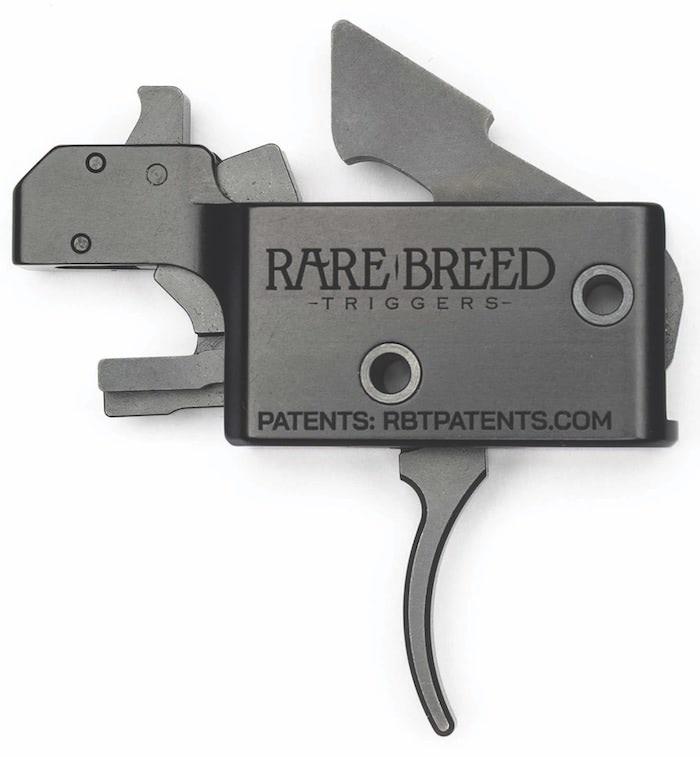
While Graves initially paved the way for FRTs, it was Rare Breed Triggers who later brought it to market for the AR-15 platform in 2020. Their FRT-15 was among the first commercially successful forced reset triggers, rapidly gaining the attention of gun owners coast to coast. This rapid increase in interest also drew the ATF's attention, culminating in 2021 when they issued a cease-and-desist letter to Rare Breed. It was in this letter that the ATF classified Rare Breed's forced reset triggers as machine gun conversion kits. This decision was later overturned by the Department of Justice in 2025.
Not wanting to miss out on their fair share of potential profits, manufacturers began entering the FRT market, competing with Rare Breed Triggers by releasing their own variations of the new trigger technology. These new options expanded on the original cassette-style design, adding selector-based super safeties and a variety of platform-specific variants.
Redacted Arms: DIY Super Safety
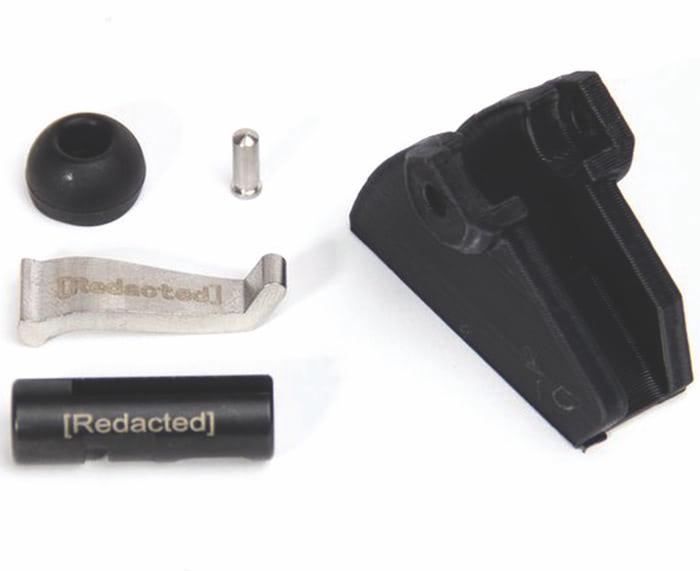
Redacted Arms’ DIY Super Safety offers a different take on forced-reset trigger systems by giving experienced gun owners the option to modify their own trigger and assemble a custom Super Safety setup, rather than relying on a pre-cut trigger or a cassette-style unit.
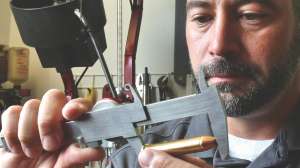
The DIY kit includes all the components you need for your project, including the Super Safety cam and lever, a rounded detent, and a trigger jig. Although most of the installation process mirrors that of similar products, the initial preparation step distinguishes this design.
Users begin by placing their chosen trigger into the included jig to establish the necessary cut reference. After the trigger is prepared and a small amount of material is removed from the interior of the opposite trigger wall, the trimmed areas are smoothed to eliminate any remaining burrs or areas of roughness. The remainder of the installation process uses the firearm's original trigger spring, hammer spring, and detent, along with Redacted Arms' cam and lever in place of the standard safety, followed by reinstallation of the grip, spring, and new detent.
Once fitted, the DIY Super Safety functions equivalently to other offerings while giving shooters greater freedom to choose the trigger they prefer. The kit is priced at $119.99, and optional add-on triggers are available for those who prefer to keep a spare ready.
Freedom Fingers – TY22 – Taurus TX22
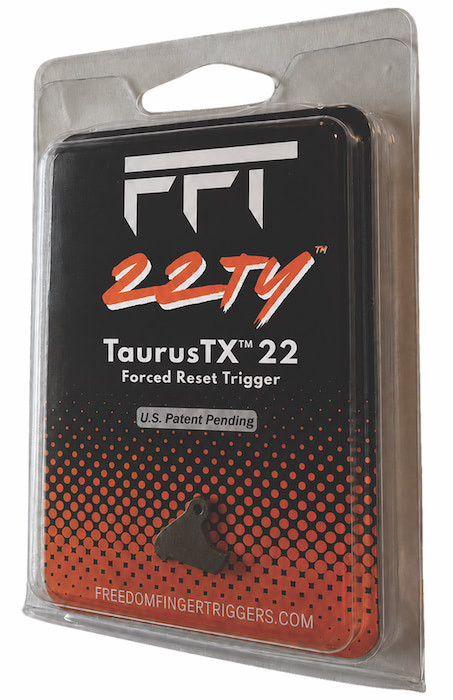
Although forced-reset triggers are most commonly associated with AR-style rifles and similar long-gun platforms, some companies are now producing handgun-specific variants as well. The Freedom-Trigger 22TY is designed exclusively for the Taurus TX22 chambered in .22LR, offering a dedicated FRT option for this pistol.
Rather than relying on multiple replacement parts like those used for installation in an AR-15 or other platform, Freedom Fingers created a single integrated unit that directly substitutes for the factory disconnect and requires no additional component changes. Installing Freedom Finger's 22TY is simple: First, the TX22's original disconnect and pins are removed, followed by swapping in the new 22TY, then lastly reinstalling the gun's factory pins. Now, upon firing, the trigger resets the moment the slide cycles mechanically, allowing the shooter to press the trigger again as soon as the slide returns to battery. This produces a significantly faster rate of fire while still maintaining a semi-automatic classification, since each trigger pull continues to fire only one round.
With its easy installation process and a modest MSRP of $125, the 22TY presents itself as quite the tempting upgrade for anyone already owning this affordable rimfire.
Going Mainstream
As technology surrounding FRT's continues to evolve, so too will the debates surrounding their place in the firearms industry. One thing that remains undeniably clear is that what was once a small niche in the market has become more mainstream than many ever thought imaginable.
This product has influenced conversations about firearm design and regulation in ways few accessories have ever managed. As a result, responsible gun owners are often left navigating a landscape that continues to shift as quickly as the technology itself. Thorough education and understanding of how items of this nature function, how they are produced, their limitations, and how they may differ in construction and installation across platforms is essential to making informed decisions in an environment where clarity is often in short supply.